
A Category That Cannot Reach Standard
Most product categories on Resourcehip have a gap between the conservative baseline and the verified ceiling. The ceiling is the best score a manufacturer can reach with credible evidence. Wireless earbuds are the exception. Even the ceiling scores only HIP 5.9. That falls short of the Standard Mark threshold of 6.0.
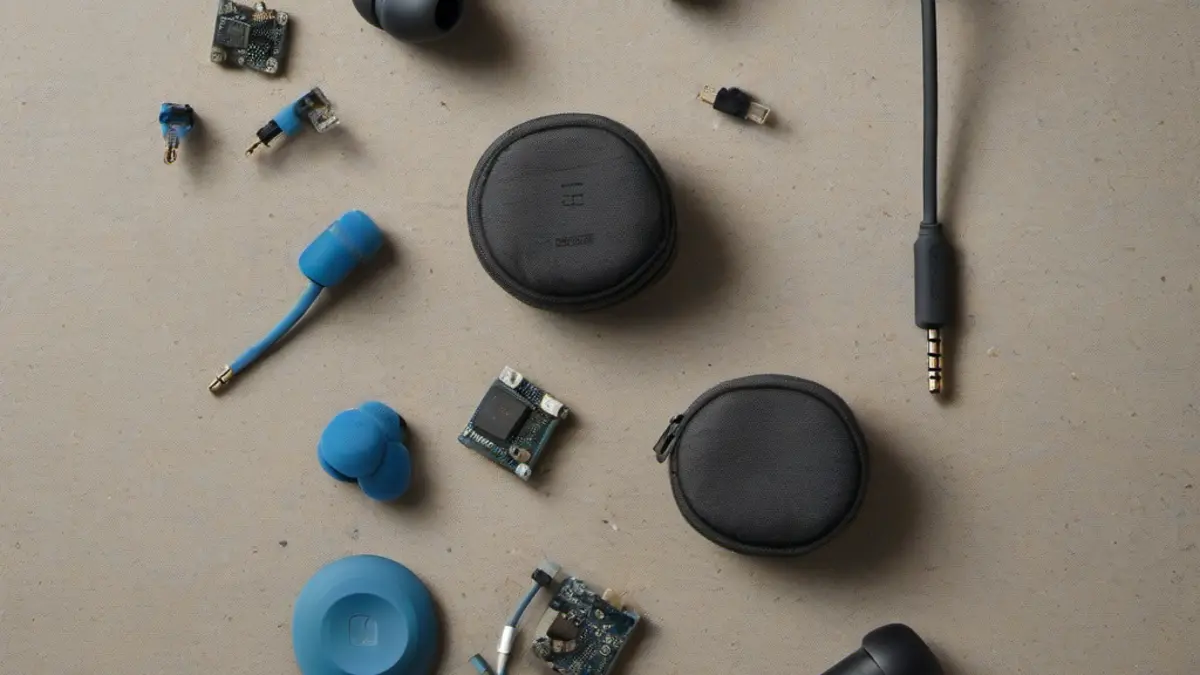
That is not about one brand or one model. It is a structural problem with the format itself. You get a sealed lithium-ion battery in a device the size of a fingertip, no affordable way to take it apart, and no realistic recycling path.
The full category breakdown is on the wireless earbuds rating page. The baseline scores 1.8/10 with RI -7.0 (Depleting).
This guide does not recommend a "best sustainable choice." There is no honest version of that in this category. Instead, it makes the trade-off clear so you can decide whether the format is right for you at all.
What HIP Measures for Wireless Earbuds
Three HIP dimensions sit at the bottom of the category:
- Repairability (R). Baseline 1/10. Earbuds are glued, sometimes ultrasonically welded (fused shut by vibration). A dead battery cannot be replaced. The ceiling reaches 9/10 only with screw-fastened or modular builds. Almost no product on sale today offers this.
- Recyclability and Circularity (RC). Baseline 1.5/10. Earbuds are too small for current e-waste recycling systems to handle affordably. The ceiling reaches 8/10 with a manufacturer-run take-back scheme and design-for-disassembly (built to be taken apart). Without that take-back, the end-of-life destination is landfill. Full stop.
- Product Longevity (PL). Baseline 2/10. How long earbuds last depends almost entirely on battery life (number of charges before it degrades) — typically two to three years. No consumer-replaceable battery exists. When the battery dies, the device dies. The ceiling at 6/10 assumes a longer warranty and improved battery technology, but the hard limit remains.
The remaining four dimensions — Material Scarcity, Supply Chain Risk, Social and Environmental Impact, and the Regenerative Index — all sit in the same low range. The story is the same: lithium and cobalt content, no recycled materials, no take-back, no audited sourcing.
Why the Ceiling Is Below Standard
Most categories have at least one manufacturer that can hit Standard. Wireless earbuds do not. A ceiling of HIP 5.9 means:
- Even with high recycled content, the device cannot be repaired.
- Even with a take-back scheme, the device is too small to recover cost-effectively.
- Even with audited sourcing, the format requires a sealed battery. That battery's lifespan caps the device's lifespan.
For comparison: robot vacuums reach HIP 6.6 (Standard). Smartphones reach 6.4 (Standard). Air fryers reach 7.1 (Standard, near Silver). Wireless earbuds sit alone below the line.
What to Check Before You Buy
The realistic checks for this category are smaller than for any other we cover:
- Take-back scheme. This is the single most important check. Without a manufacturer-run return path, the device goes to landfill. With one, the lithium can be recovered. There is no kerbside recycling route for sealed earbuds with embedded batteries.
- Replaceable battery, if you can find one. Almost no product on sale offers this, but a small number do. A replaceable battery is the only design choice that turns wireless earbuds from a 2–3-year throwaway into something that lasts.
- Warranty length. Two years is the EU floor and the category norm. Five years would be unusual. It signals a manufacturer betting the device will outlast the typical battery-failure window.
- Open-protocol pairing (connecting via standard Bluetooth, not locked to one brand). Earbuds locked to a single ecosystem can become useless if the app shuts down or your account closes. Standard Bluetooth earbuds do not have this problem.
We do not name brands.
A Note on Wired Headphones
Wired headphones are not in scope for this rating, and we will not score them. They have a fraction of the embodied cost (the environmental cost of making and disposing of it) of wireless earbuds. No battery, no charging case, no wireless chip. They routinely last decades with simple cable repairs. If lifetime environmental impact matters to you, and you can live without wireless, that is a real alternative.
How to Read a Resourcehip Wireless-Earbud Rating
Every wireless-earbud listing on Resourcehip carries:
- A HIP score from 0 to 10, measured against the wireless-earbud category baseline.
- A Regenerative Index from -10 to +10, with a tier name (Depleting, Extractive, Renewable, Restorative, Regenerative).
- A HIP Mark on verified ratings only, when the score reaches 6.0 or higher: Standard at 6.0, Silver at 7.5, Gold at 9.0 with RI ≥ +6. Verified ratings below 6.0 — currently the entire category ceiling — do not carry a Mark.
Category Baseline ratings sit at the conservative default. Verified Ratings can climb toward the ceiling. In this category, even the ceiling is below Standard.
For the methodology, see How HIP scoring works. For every pair of wireless earbuds we have rated:
The Bigger Picture
Wireless earbuds are the one category where the honest answer to "which is the most sustainable?" is "the category itself is the problem." That is not a sales-stopper. Convenience matters, and we are not here to moralise. But it is the right context for any purchase in this category.
When a manufacturer ships a pair that breaks Standard, we will be the first to call it out. Until then, treat any wireless-earbud purchase as a 2-to-3-year commitment with a take-back plan attached.
Methodology and edits by Chris Bowness; assistive AI used for drafting.