
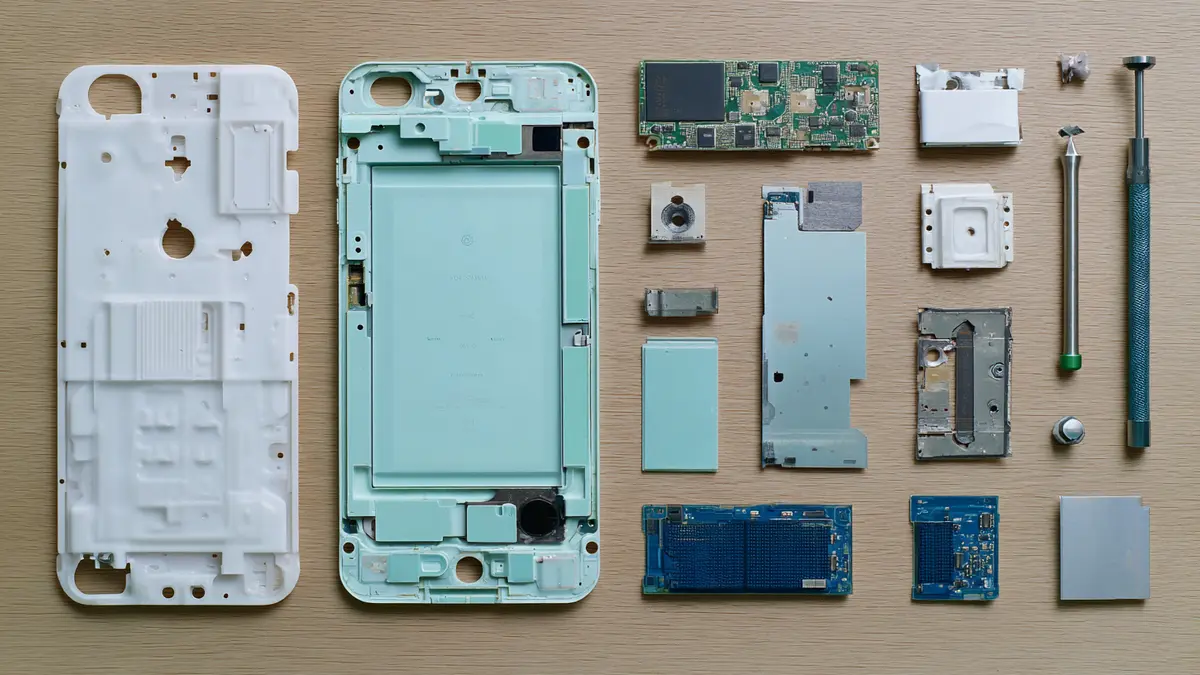
The Problem
Roughly 1.4 billion smartphones are made each year. Most are designed for a 2-4 year replacement cycle. Most of what goes into them — lithium, cobalt (a battery material), rare earth elements, tantalum (a rare metal) — sits on the EU Critical Raw Materials list (a list of materials at risk of supply shortage). As a category, smartphones are one of the worst-performing consumer goods we score.
How bad? On the Human Impact Profile (HIP), the smartphone baseline is 1.9 out of 10. That is a cautious score for a typical device with no maker evidence supplied. The full breakdown is on the smartphones rating page.
What "Sustainable Smartphone" Actually Means
The HIP score for smartphones moves on seven dimensions. Three dominate the conversation:
- Material Scarcity (MSI). Lithium, cobalt, rare earths, and tantalum all make up a meaningful amount of a phone's weight. The baseline scores 1.5/10 here. Recycled content above 50%, with verified take-back, is what moves the needle.
- Repairability (R). A typical phone is glued shut and ships with no public repair manual. That scores 1/10. A device with screw-fastened construction, a 10-year spare-parts commitment, and a public repair manual scores a perfect 10.
- Recyclability and Circularity (RC). Without disassembly access and a verified take-back scheme, less than 20% of a phone enters real-world recycling. The ceiling pushes that to 70%+.
The other four dimensions — Supply Chain Risk, Social and Environmental Impact, Product Longevity, and the Regenerative Index — all matter. They tend to follow the same fixes: cleaner sourcing, longer warranty and software support, and verified third-party audits.
The Gap Between Baseline and Ceiling
The smartphone category ceiling — what a verified, fully evidenced maker submission can achieve today — is 6.4 out of 10. The Regenerative Index moves from -7.0 (Depleting) to -2.0 (Extractive). The ceiling earns the Standard HIP Mark.
That is a 4.6-point HIP gap, and a shift across five Regenerative Index tiers, between the baseline and what is achievable today. Closing that gap comes down to:
- Recycled content moving from 5% to 50%+
- Disassembly moving from glued to screw-fastened
- Spare-parts commitment moving from "none" to a decade
- Take-back moving from absent to verified
- Software support moving from "as long as we feel like it" to 8 years stated
None of those are exotic. They are choices.
What to Check Before You Buy
- Look for a published iFixit-style repair score. Above 7 means screw-fastened construction and accessible internals. Below 4 means a glued, sealed device.
- Confirm a long, stated software-support window. Five years minimum. Eight is what the ceiling looks like. Without it, the device becomes e-waste while the hardware still works.
- Ask for a take-back scheme. Recyclability without a return path is just theory. The ceiling assumes a verified maker-run take-back.
- Check the warranty and IP rating (water- and dust-resistance grade). A two-year warranty is the EU floor. Five years signals the maker expects the hardware to last. An IP55 rating or better guards against the water-splash damage that quietly retires millions of phones.
We do not name brands in our guides — we score against the category baseline. The four checks above are visible on any maker's product page if you look.
How to Read a Resourcehip Smartphone Rating
A smartphone listing on Resourcehip carries:
- A HIP score from 0 to 10, calculated against the smartphone category baseline.
- A Regenerative Index from -10 to +10, with a tier name (Depleting, Extractive, Renewable, Restorative, Regenerative).
- A HIP Mark, awarded only to verified ratings: Standard at 6.0, Silver at 7.5, Gold at 9.0 with RI ≥ +6.
Category Baseline ratings — the ones you see when no maker has submitted evidence — do not earn a HIP Mark. They are cautious by design. Verified Ratings, where the maker can show the receipts, can sit anywhere up to the ceiling.
For the full methodology, see How HIP scoring works. For a wider view of every smartphone we have rated:
The Bigger Picture
The smartphone category is one of the hardest tests a sustainability rating can face. Almost everything that makes a phone good — the rare-earth magnets, the cobalt battery, the bonded glass front (glued-on screen) — also makes it hard to repair, hard to recycle, and hard to source cleanly. The category will not improve until buyers treat those properties as primary criteria, not afterthoughts. HIP scoring exists to make that trade-off clear at the point of purchase.
Methodology and edits by Chris Bowness; assistive AI used for drafting.