
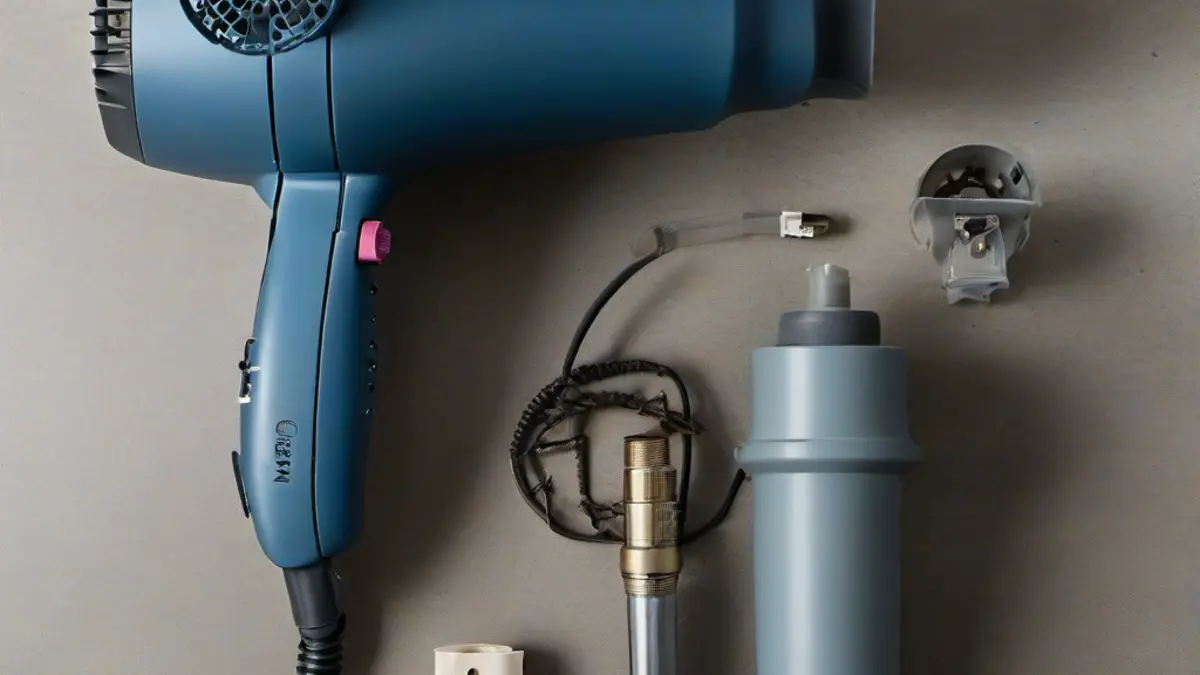
A Durable Motor Bolted Inside a Disposable Plastic Shell
A hair dryer is, mechanically, one of the more durable small appliances we rate. A modern brushless motor will run for thousands of hours before showing wear. The plastic shell, the switch, and the heating element are the parts that fail. Most of them fail because the device was built to be replaced, not repaired.
That mismatch is the story for this category. The parts that cost the planet to make (motor, copper windings, magnets) are the parts that last. The cheap parts (housing, switch, cable strain relief (the part where the cable meets the body)) are the parts that end the device's life. The Resourcehip Human Impact Profile rates the appliance end-to-end. By that measure, the typical mass-market hair dryer scores 2.6 out of 10. The full breakdown is on the hair dryers rating page.
What HIP Measures for a Hair Dryer
Three HIP dimensions dominate the category:
- Repairability (R). Baseline 2/10 — glued housings, no spare switches, no replaceable cable, no repair manual. Ceiling 8/10 with screw-fastened access, stocked spare parts, and a published repair manual. The motor itself is rarely the issue.
- Material Scarcity (MSI). Baseline 2/10 — copper-wound motors (copper is an EU Strategic Raw Material under CRM Act 2024/1252) and rare-earth magnets in the brushless variants (rare earths are EU Critical Raw Materials with high supply risk). Ceiling 5.5/10 with less critical-material content and partial recycled inputs.
- Recyclability and Circularity (RC). Baseline 3/10 — glued ABS (a rigid plastic) housings prevent real-world disassembly. Ceiling 8/10 with screw-based disassembly and a manufacturer take-back scheme.
The broader point: almost every failure that retires a hair dryer involves a non-motor part. Almost every non-motor part could be made replaceable. The only reason they are not is commercial.
The Gap Between Baseline and Ceiling
The hair-dryer category ceiling is HIP 6.5 / RI -2.0 (Extractive), earning the Standard HIP Mark.
That is a 3.9-point HIP gap and a shift across five Regenerative Index tiers between a typical mass-market hair dryer and what is technically possible today. Closing it requires:
- Recycled content moving from 0% (assumed) to 50%+
- Screw-fastened housing access
- A multi-year stocked spare-parts programme covering switch, cable, filter, and heating element
- Take-back moving from absent to manufacturer-run
- Design life moving from 5 years to 10+ — a number the underlying motor easily supports
Of all the categories we have reviewed, this is among the easiest to improve. The motor is already durable. The supply chain is already mature. What is missing is the will to design the rest of the product to match.
What to Check Before You Buy
- Look for a replaceable cable. Hair-dryer cables fail more often than the motor. They bend at the strain relief, kink at the plug, and fray near the handle. A model with a standard detachable cable or screw-accessible terminals is a very different product to one with a moulded-in cable.
- Confirm a stocked switch and filter. The switch and the lint-collecting rear filter are the second and third most common failure points. Manufacturers who stock these as separate spare parts score much higher on Repairability.
- Check the warranty length. Two years is the EU floor. Five years is unusual but shows the manufacturer trusts the build. Trade and salon-grade lines often carry longer warranties than home versions of the same brand.
- Avoid models whose marketing leans on cosmetic features. A coloured housing, gloss finish, or LED ring rarely affects durability. But it is often the reason the device gets replaced before the motor wears out.
We do not name brands. The four checks above are visible on any manufacturer's product page if you look for them.
How to Read a Resourcehip Hair-Dryer Rating
Every hair-dryer listing carries:
- A HIP score from 0 to 10, calculated against the hair-dryer category baseline.
- A Regenerative Index from -10 to +10, with a tier name (Depleting, Extractive, Renewable, Restorative, Regenerative).
- A HIP Mark on verified ratings only: Standard at 6.0, Silver at 7.5, Gold at 9.0 with RI ≥ +6.
Category Baseline ratings sit at the conservative default. Verified Ratings, where the manufacturer can show the receipts, can climb up to the ceiling.
For the methodology, see How HIP scoring works. For every hair dryer we have rated:
The Bigger Picture
Hair dryers are a category where the product's environmental performance is far below its potential. The underlying engineering — durable motor, simple heater, basic switch — is almost a textbook case for a multi-decade product. What stops that is design choices tied to refresh cycles, not technical limits. The first manufacturer to publish a repairable, screw-accessible hair dryer with a 10-year spare-parts commitment will not be doing anything new. They will simply be doing the obvious.
Methodology and edits by Chris Bowness; assistive AI used for drafting.